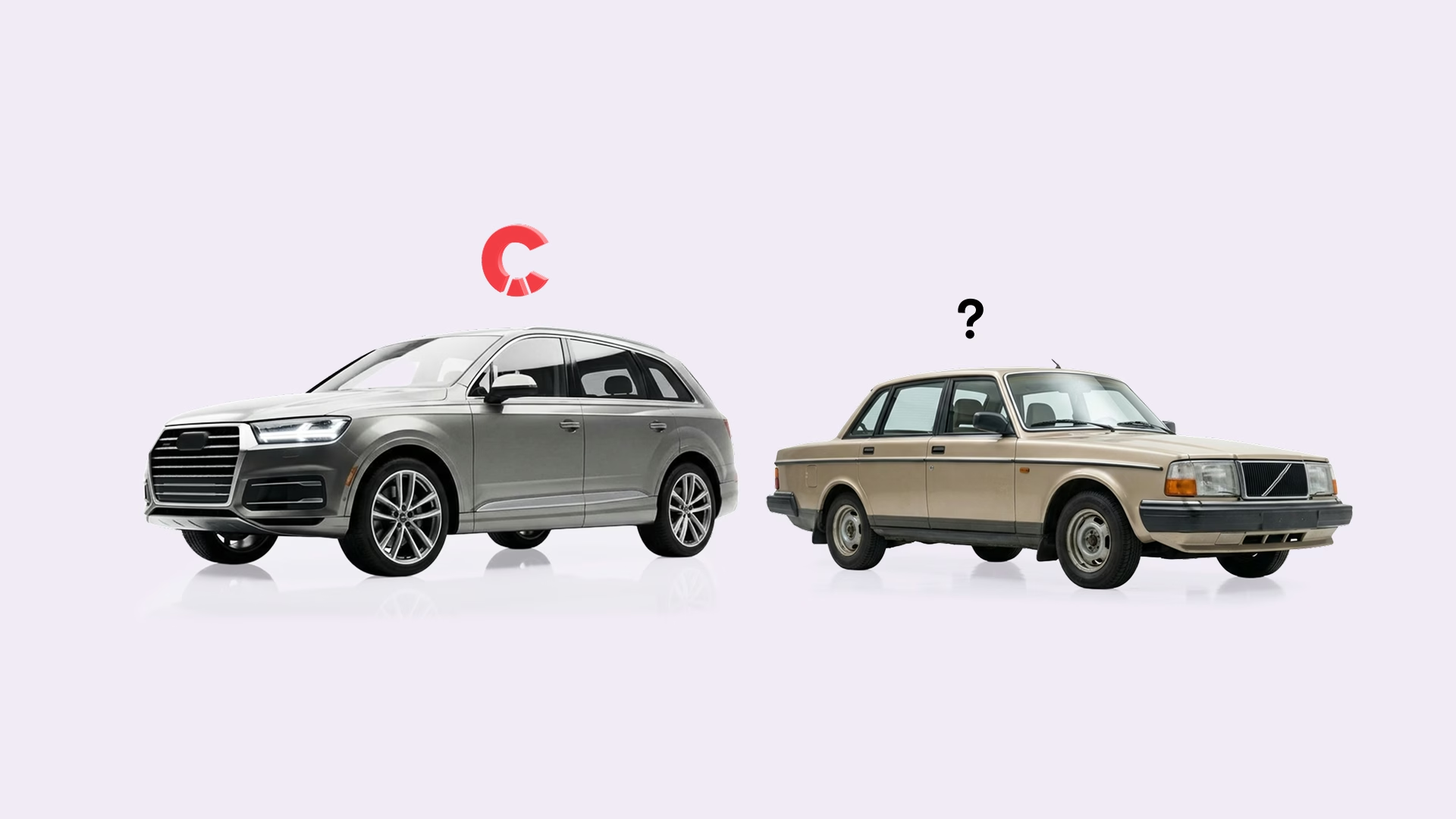
The 210-point inspection is the standardized check Clutch runs on every vehicle considered for retail sale. It covers 210 individual checkpoints across nine areas of the car, including a 79-point road test (split into a stationary cabin-and-controls phase and a driving phase) that puts the vehicle through real-world conditions. The same checklist applies to every car, regardless of brand, age, or mileage. Only 40% of the cars Clutch buys make it through. The 60% that don't are sent to dealer-only auctions, where other dealerships buy them and resell them on their own lots.
Key Takeaways
- Every Clutch vehicle is checked against the same 210-point standard before it can be listed.
- The 210 points cover nine categories of the car, including a 79-point road test (55 stationary + 24 driving).
- Inspections are run across five stations: Submission, Full Inspection, Safety, QC, and Pre-delivery.
- Inspections are run by Clutch's own mechanics at our reconditioning facilities, not third-party services.
- Three in five cars Clutch buys don't make the cut; they're sold to other dealers through dealer-only auctions.
- Every Clutch listing comes with a free CARFAX vehicle history report.
What is the Clutch 210-point inspection?
The 210-point inspection is the operational filter that decides what shows up on clutch.ca. It's a standardized quality check Clutch runs on every used vehicle considered for retail sale. The same 210 items get checked regardless of which brand, year, or model is being inspected. The standard exists to do one thing reliably: separate cars that meet our retail bar from cars that don't.
The inspection is run by Clutch's own trained mechanics, working at our reconditioning facilities. There's no third-party service involved, no quick visual once-over, and no abbreviated version for less expensive vehicles. Every car gets the same checklist.
What does the 210-point inspection actually check?
The 210 checks are split across nine categories of the vehicle, with the largest single category being the 55-point Stationary Road Test (cabin and controls). The remaining 155 points cover static and on-road inspection of the engine, body, suspension, steering, brakes and tires, lights, underbody, and a 24-point driving phase. Every category uses a fixed checklist; the same items apply to every car.
What each category covers:
Stationary Road Test (55 checks). Everything that can be verified with the engine on but the car parked: door locks, window operation, defrost, blower controls, all 12V ports, every interior light, every speaker, navigation, Bluetooth, parking sensors, seat adjustments and seat belts in every position, mirrors, the trunk release, the fuel-door release, and so on. Many shoppers underestimate how much of a used car experience is interior; the stationary test is where it gets verified.
Engine (41 checks). Oil level and condition, coolant level and reservoir, fluid leaks, drive belts, hoses, fuel system integrity, engine mounts, transmission mounts, battery condition and connections, ignition function, exhaust function, drive shaft and differential, hybrid-system electrical (if applicable), engagement in Drive/Neutral/Reverse.
Tires & Brakes (25 checks). Tread depth at all four corners, sidewall condition, tire pressure consistency, brake pads, rotors, brake lines (corrosion, leaks, bulging), ABS, master cylinder, parking brake, wheel hubs, wheel fastener torque, and pedal travel under pressure. Clutch's standard goes beyond the legal minimum here: 3.2mm minimum brake pad thickness (Ontario's legal minimum is 1.6mm) and 4mm minimum tread depth (above most CPO programs and double the legal minimum).
Driving Road Test (24 checks). Dynamic performance under real-world driving: cruise control, transmission shifts, steering pull and return-to-centre, stopping distance, suspension response, on-board diagnostics, exterior and interior noise (rattles, squeaks, wind), warning lights at operating temperature, and gauge function while driving.
Body (21 checks). Panel gaps, paint quality, doors and trunk function, hood latch, mirrors, windshield, exterior trim alignment, license-plate brackets, and sub-frame integrity. Any signs of repair or paint work get flagged.
Suspension (16 checks). Springs, shocks, control arms, ball joints, bushings, ride height, anti-sway bars, oscillation tests, and any axle or load-cushion concerns.
Underbody (11 checks). Frame condition, perforated rust, exhaust system integrity, fluid leaks (engine, transmission, brakes, cooling system, washer system), motor/transmission mounts, and the belly pan.
Lights (10 checks). Headlights, tail lights, signals, hazards, daytime running lights, parking lights, reverse lights, license-plate lights, instrument-panel lights, and high beams.
Steering (8 checks). Power steering function, tie rods, ball-and-socket joints, steering box, steering column, telescopic adjustments, and steering control arms.
The same 210 items apply to a 2-year-old Civic and a 9-year-old Mercedes. The categories don't change with the brand or vintage of the car being inspected.
How does the inspection move through Clutch?
The 210-point inspection runs across five stations, each with its own sign-off. It isn't a single visit to one bay. Cars move through a structured workflow where multiple Clutch mechanics handle different stages.
- Submission. Initial assessment when the car arrives. The condition is documented and the car is queued for full inspection.
- Full Inspection. All 210 points are checked. This is where the bulk of the work happens.
- Safety. A dedicated provincial safety check (Safety Certified in Ontario, Motor Vehicle Inspection in Nova Scotia, equivalents in other provinces).
- QC. Quality control review. Anything flagged in earlier stations is verified, and the car is double-checked against the standard.
- Pre-delivery. Final sign-off before the car reaches the customer. Includes a final road test at operating temperature.
Each station involves its own sign-off, so most Clutch cars are road-tested multiple times across the process.
"The hardest things to catch are intermittent warning lights and issues that only surface once the engine reaches operating temperature. Running multiple road tests at different temperatures is how we trigger most of them." — Dusan Ramnjanc, GM of Ontario Production at Clutch
What happens when a car doesn't pass?
Cars that don't pass don't get listed on clutch.ca. They go through one of two paths: minor or moderate issues get addressed in reconditioning before the car is listed, or significant issues send the car to dealer-only auctions, where used car dealerships buy them and resell them on their own lots. Only 40% of the cars Clutch buys make it through to retail.
The dividing line is whether the cost or scope of repair fits Clutch's retail standard. Brake pads, alignment, a worn belt, glass damage, or cosmetic touch-ups all get addressed in reconditioning. Significant rust, drivetrain failures, engine compression problems, or major collision damage send the car to wholesale instead.
The most common reasons a vehicle ends up in wholesale, based on Clutch's analysis of inspection failures: rust (48.5% of failed inspections), engine failure (40.8%), drivetrain or transmission issues (29.7%), fluid leaks (16.5%), aftermarket modifications (16.2%), and cosmetic damage beyond paintless dent repair (15.5%).
For more on what gets caught and why, see What happens to cars that don't pass.
Are all 210 points checked on every car?
Yes. The same 210 items are checked on every vehicle Clutch evaluates for retail sale. There's no abbreviated version for older cars, no shortcut for higher-mileage inventory, and no different checklist by brand. The standard is fixed.
That's deliberate. A buyer comparing a 4-year-old Honda CR-V to a 7-year-old Toyota RAV4 on clutch.ca knows both went through the same checks. Trust comes from the consistency, not the marketing.
Every Clutch listing also includes a free CARFAX vehicle history report alongside the inspection report, so the inspection sits inside a broader paper trail buyers can read before they decide.
Browse Clutch Certified inventory
Every Clutch Certified vehicle has cleared the 210-point inspection across the five stations, been reconditioned to the standard, and is backed by a 10-day return policy.
FAQs About Clutch's 210-Point Inspection
How long does the Clutch inspection take?

The full 210-point inspection plus the road test typically runs several hours per vehicle, performed at one of Clutch's reconditioning facilities. Cars that pass move into reconditioning; cars that don't are flagged for wholesale.
Does Clutch inspect every car it sells?
Yes. Every vehicle Clutch lists for retail sale on clutch.ca has been through the same 210-point inspection, regardless of brand, year, or mileage. There are no exceptions, abbreviated versions, or trim-tier shortcuts.
Can I see the inspection report?
Yes. Every Clutch listing includes a full inspection report showing what was checked and what was repaired during reconditioning. The report is available before purchase, not just after delivery.
What's the difference between a Clutch inspection and a pre-purchase inspection?
A traditional pre-purchase inspection is something a buyer pays for ($150-$300 typical), usually at an independent mechanic, before agreeing to buy a private-sale or non-CPO dealer car. The Clutch inspection happens before the car is listed, is included in the price, and has already removed cars that wouldn't pass. You're not paying for it as an extra step.
Is a 210-point inspection better than a 100-point inspection?
More points isn't automatically better. What matters is what's actually being checked, who's doing it, and whether the standard is consistent across all cars. The Clutch 210-point inspection covers significant ground (especially with the 79-point road test), is run by trained Clutch mechanics, and is applied uniformly to every vehicle.
What happens if Clutch finds something during inspection?
Minor and moderate issues get fixed in reconditioning before the car is listed. Significant issues, like major rust, engine failure, or drivetrain problems, send the car to wholesale auctions instead. Roughly half the cars Clutch buys end up in wholesale rather than retail.
.avif)