

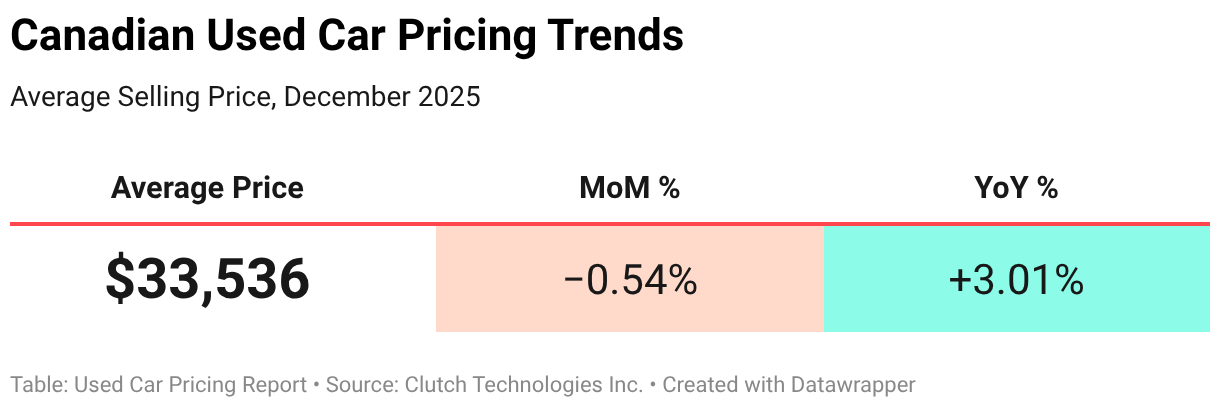
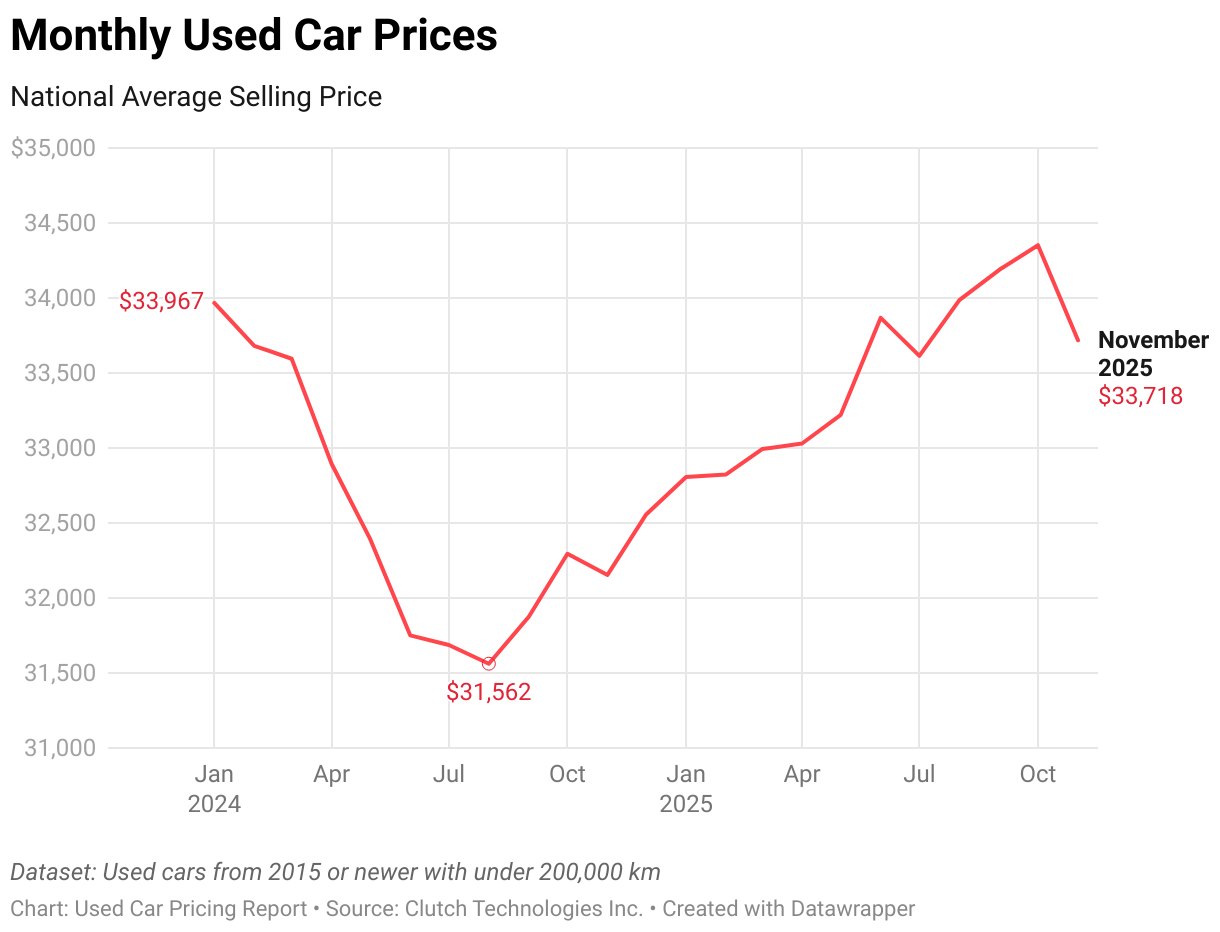
Canada’s used vehicle market ended 2025 with a national average selling price of $33,718, a 4.6% increase year over year and a -1.8% dip month over month. Despite the annual jump in price, most vehicles got cheaper throughout the year, and the increase was caused by bigger sales numbers for pricier models.
The used EV market continued to mature. Sales reached new highs while average EV prices declined, showing that buyers had access to more models and stronger supply than in prior years. SUVs also strengthened their position. They continued their multiyear trend of taking share from traditional cars, helped by demand for compact and subcompact crossovers.
Across all fuel types and body styles, the mix of vehicles on the market shifted toward larger and more premium inventory. Trucks, crossovers, electrified vehicles, and higher-trim models all became more common. This shift pushed the national average upward even though many individual models experienced like-for-like price declines.
Overall, 2025 reflected a shift in consumer preferences and available supply. What Canadians chose to buy had the largest impact on the year’s pricing landscape.
2025 Superlatives
When you dive into the numbers, some fun and interesting trends start to surface—some expected, others genuinely surprising. A lot of used cars changed hands in 2025, and each province leaves its own distinct mark on the used-car market. Looking across the full year gives us a chance to see who stands out, who spends big, and how preferences vary coast to coast.
In 2025…
Canadians purchased 969,826 used cars.
Line them all up bumper-to-bumper, and they’d stretch for over 4,364 km — the distance from Toronto to Vancouver.
That amounted to $32.6B spent.
Enough to buy the Toronto Maple Leafs, Blue Jays, Montreal Canadiens, Dallas Cowboys and New York Yankees at their most recent valuations.
Blue was Canada’s favourite colour in 2025.
It was the colour of choice for 9.4% of all used-car sales and topped the charts in every province. That’s 250 Costco parking lots chock full of blue cars as far as the eye can see.
*Note: These sales figures represent a sample of used vehicles that are 2015 or newer with fewer than 200,000 km, as of November 2025. Official used vehicle registrations typically reach 3 million annually.
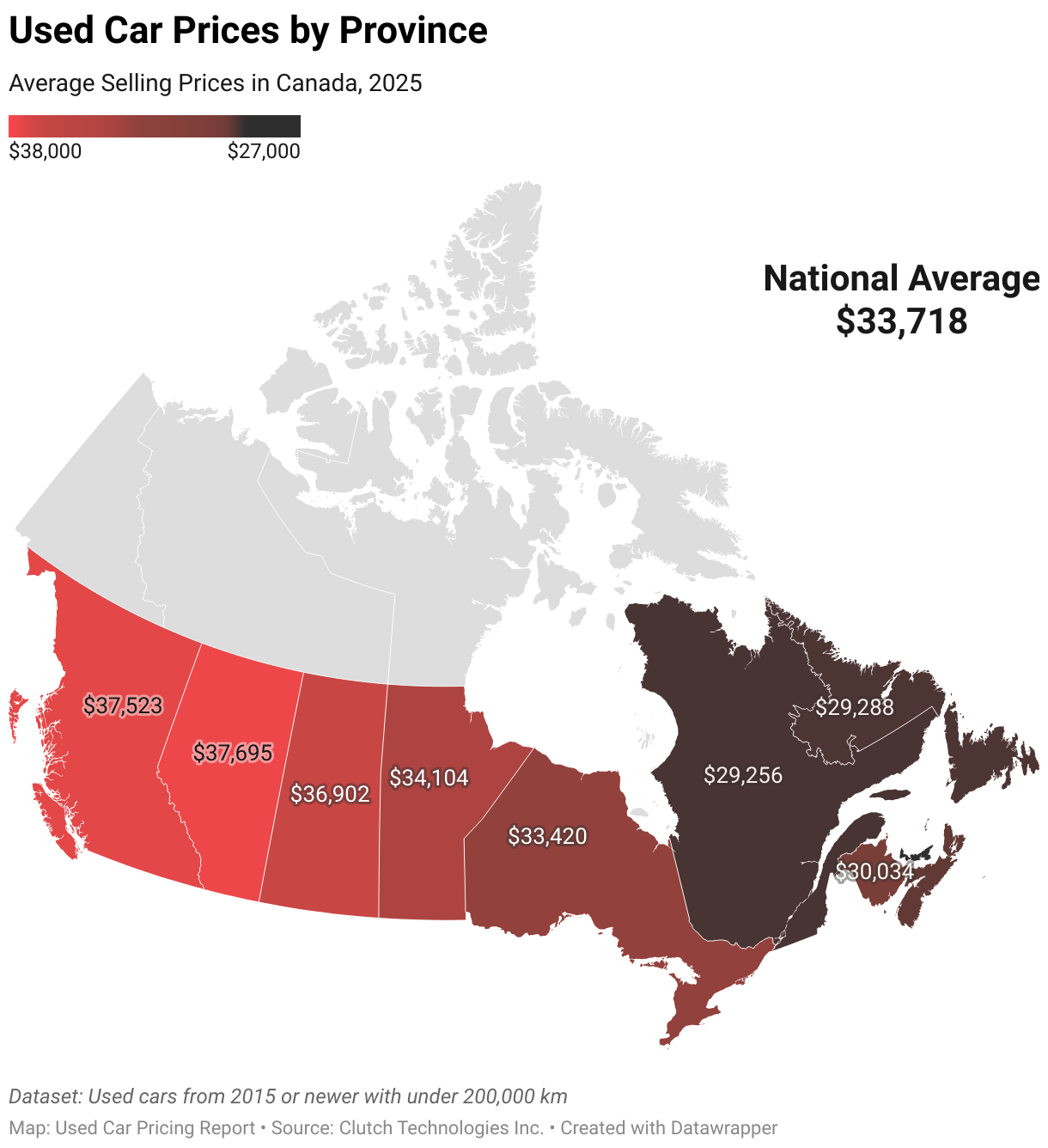
Now that we’ve covered some national numbers, it’s time to hand out the hardware to the provinces that earned a spot in Canada’s 2025 automotive yearbook.
Most Expensive Market
Alberta — $37,695
Alberta takes the crown for Canada’s priciest used-car market. A big part of that comes down to what Albertans like to buy: trucks, larger SUVs, and newer, higher-spec vehicles. Even on a like-for-like basis, vehicles tend to sell for more here than in the rest of the country. A dry climate that’s easier on vehicles and one of the highest household incomes in Canada keeps higher-value inventory in demand—and priced accordingly.
Most Affordable Market
Prince Edward Island — $29,050
PEI lands at the opposite end of the spectrum with the lowest average selling price in Canada. A higher share of older, lower-priced cars and compact SUVs keeps the market accessible, and the province consistently posts one of the strongest affordability mixes nationwide. It’s the place where used-car dollars stretch the furthest.
Biggest Price Jump
Prince Edward Island — +6.0% YoY
PEI tops the list for the fastest YoY price growth, and it wasn’t alone. Quebec, New Brunswick, and Nova Scotia posted large increases as well. Meanwhile, the higher-priced western markets like Alberta and British Columbia saw some of the smallest gains. In other words, the gap between Canada’s cheapest and priciest provinces narrowed slightly in 2025, driven not by western prices dropping but by eastern markets climbing faster from a much lower starting point.
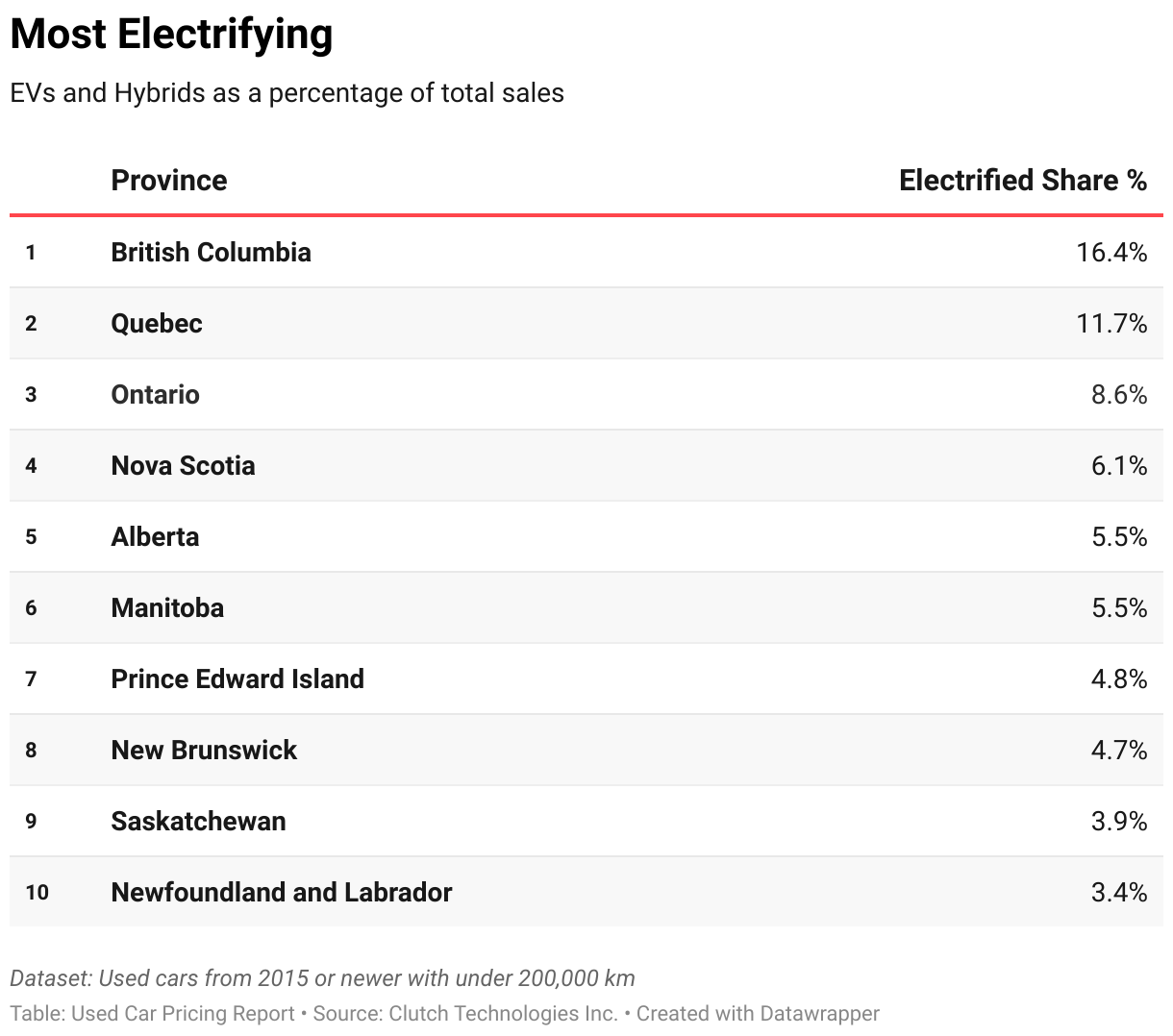
British Columbia — 16.4% EV + Hybrid Share
BC continues to lead the country in electrified adoption, and it isn’t close. A strong charging network, long-standing provincial incentives, and consumers who embraced EVs earlier than the rest of Canada all help keep BC at the top. The province is the closest thing we have to a mature EV ecosystem.
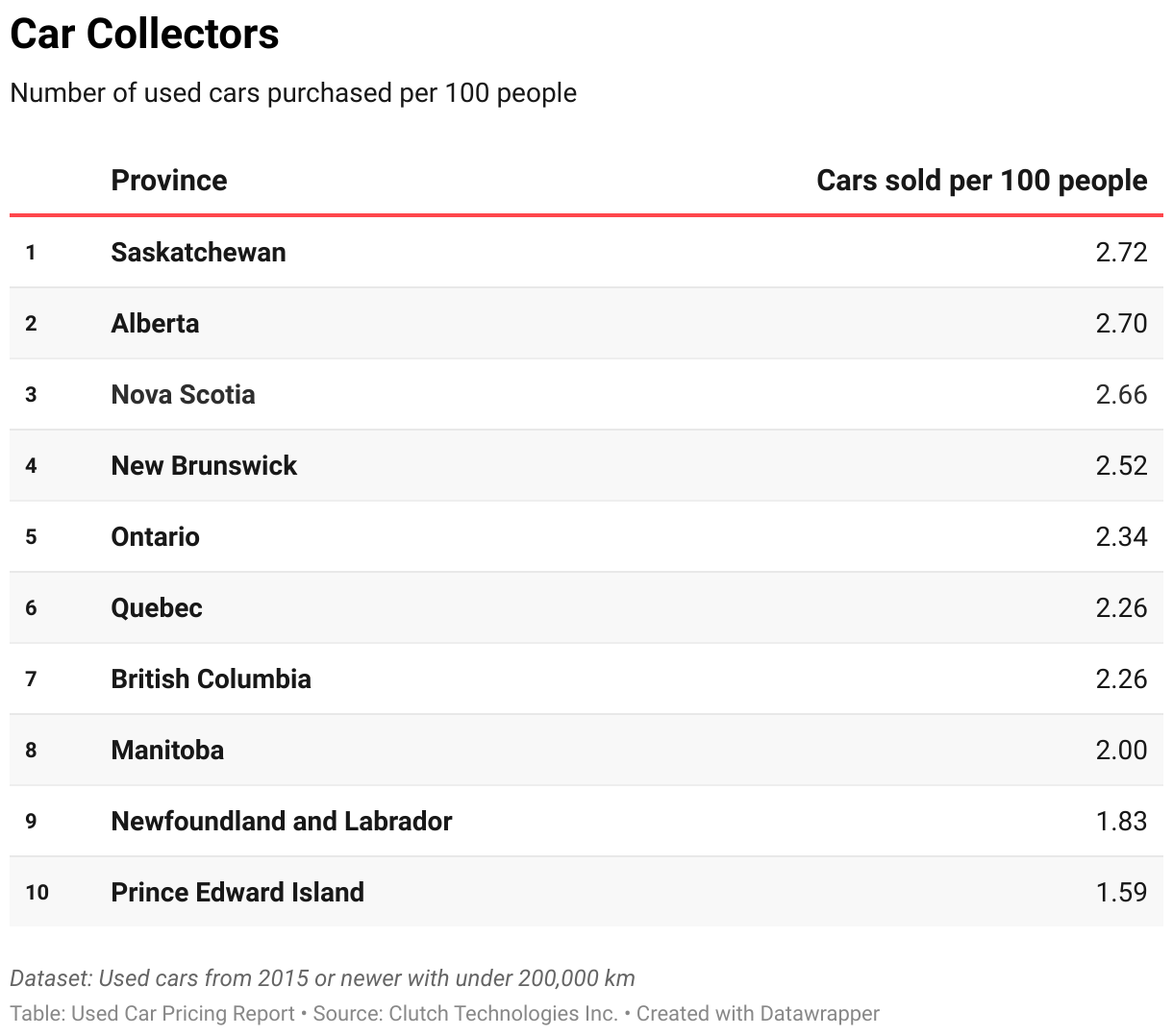
Saskatchewan — 2.7 Used Cars Purchased per 100 People
Saskatchewan quietly racks up the highest per-capita used-car buying rate in the country. Wide-open geography, vehicle-heavy lifestyles, and a strong preference for owning multiple vehicles show up clearly in the math. Saskatchewan drivers keep their driveways busy.
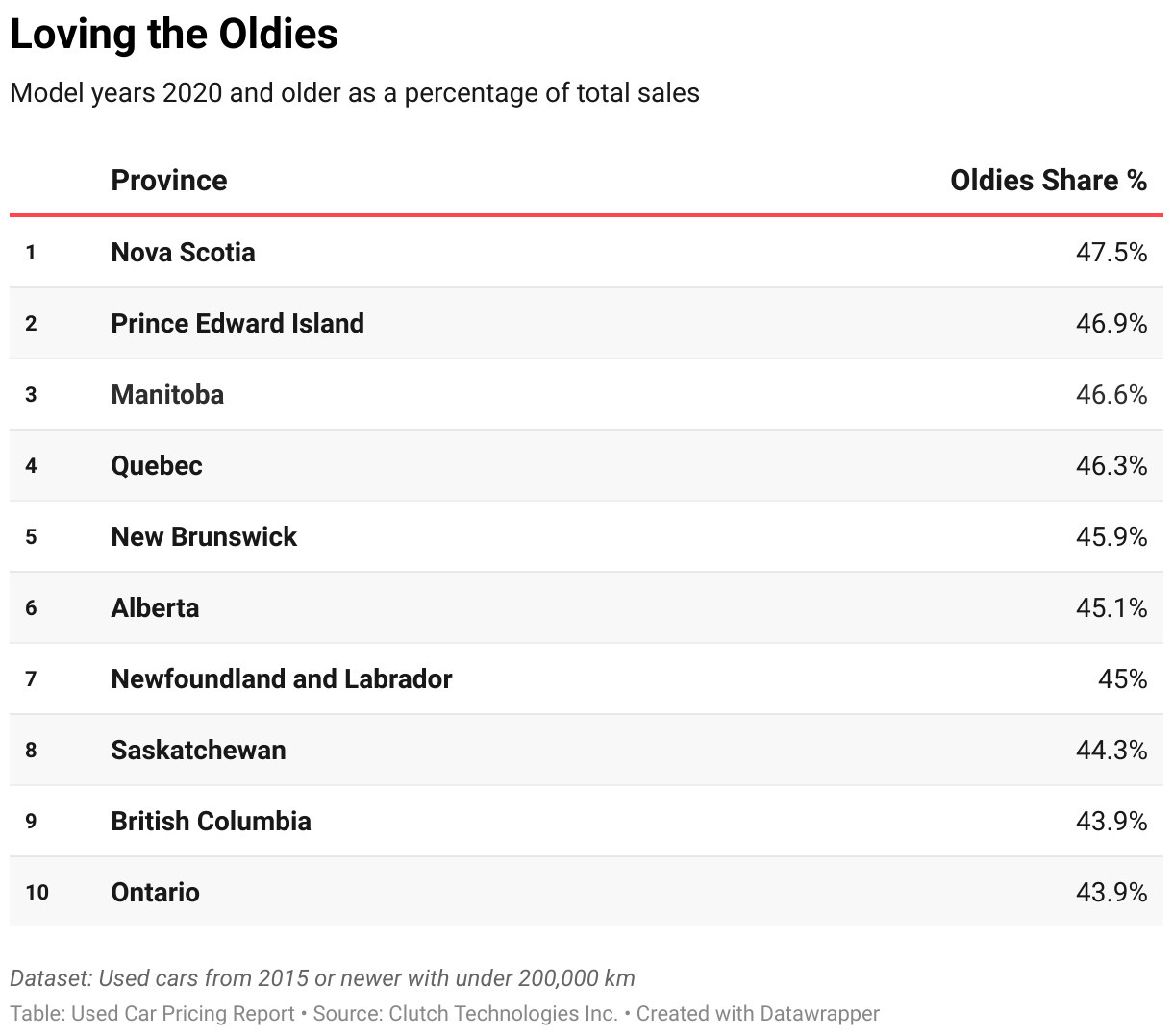
Nova Scotia — 47.5% of Vehicles Sold Over 5 Years Old
Nova Scotia stands out as the haven for older, budget-friendly cars. Nearly half of all used vehicles sold in the province were more than five model years old, reflecting a strong culture of value buying and a marketplace where older inventory turns quickly.
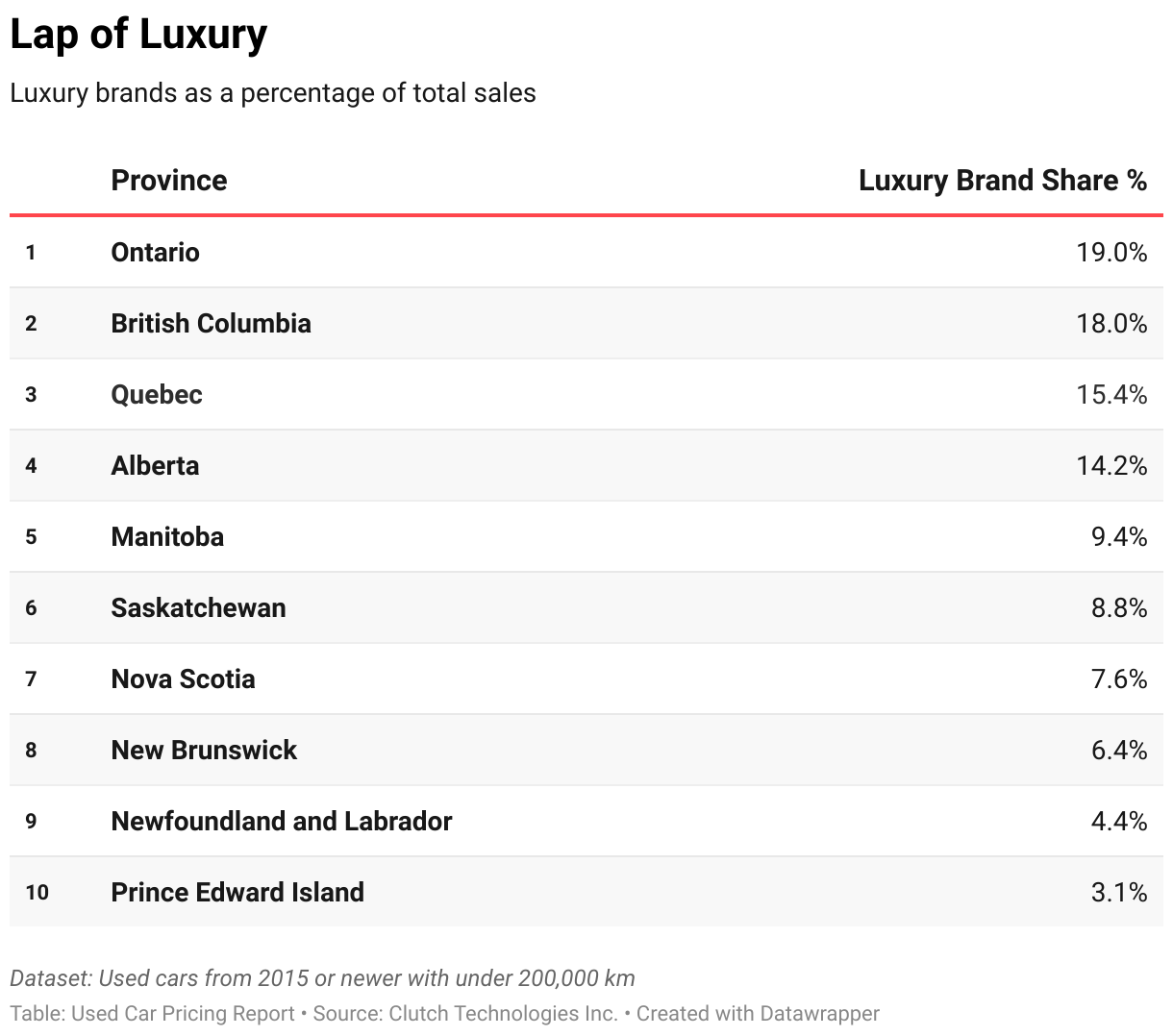
Ontario — 19% Luxury Brand Share
Ontario sits at the upscale end of the used market, with nearly one in five vehicles coming from luxury brands. A larger urban population, higher incomes in key metros, and deeper inventory pools help make premium vehicles more common here than anywhere else in the country.
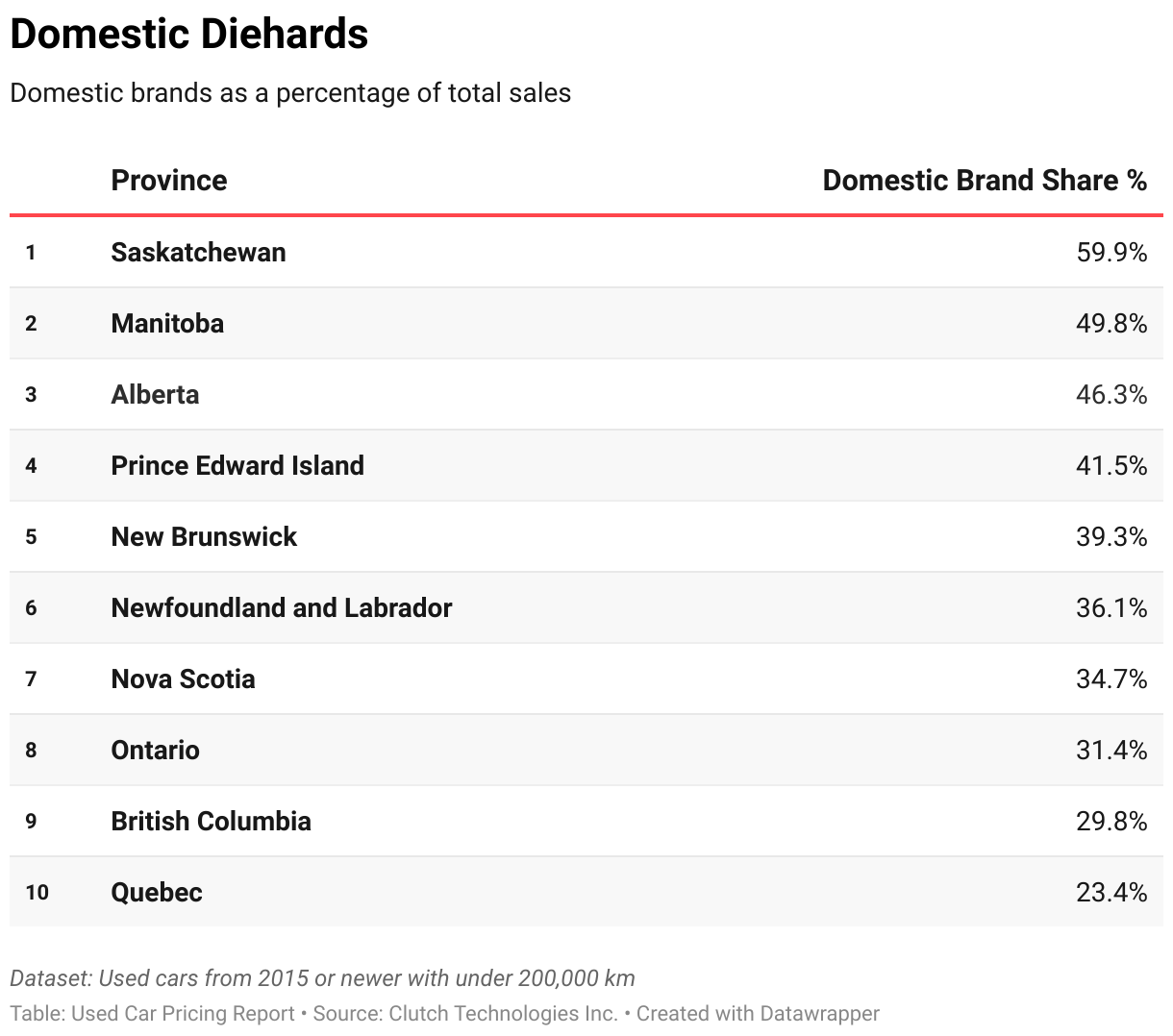
Saskatchewan — 60% domestic brand share
Saskatchewan continues to favour North American nameplates more than any other province. Sixty percent of used vehicles sold are from domestic brands, reflecting a strong preference for trucks and SUVs that match prairie driving needs.
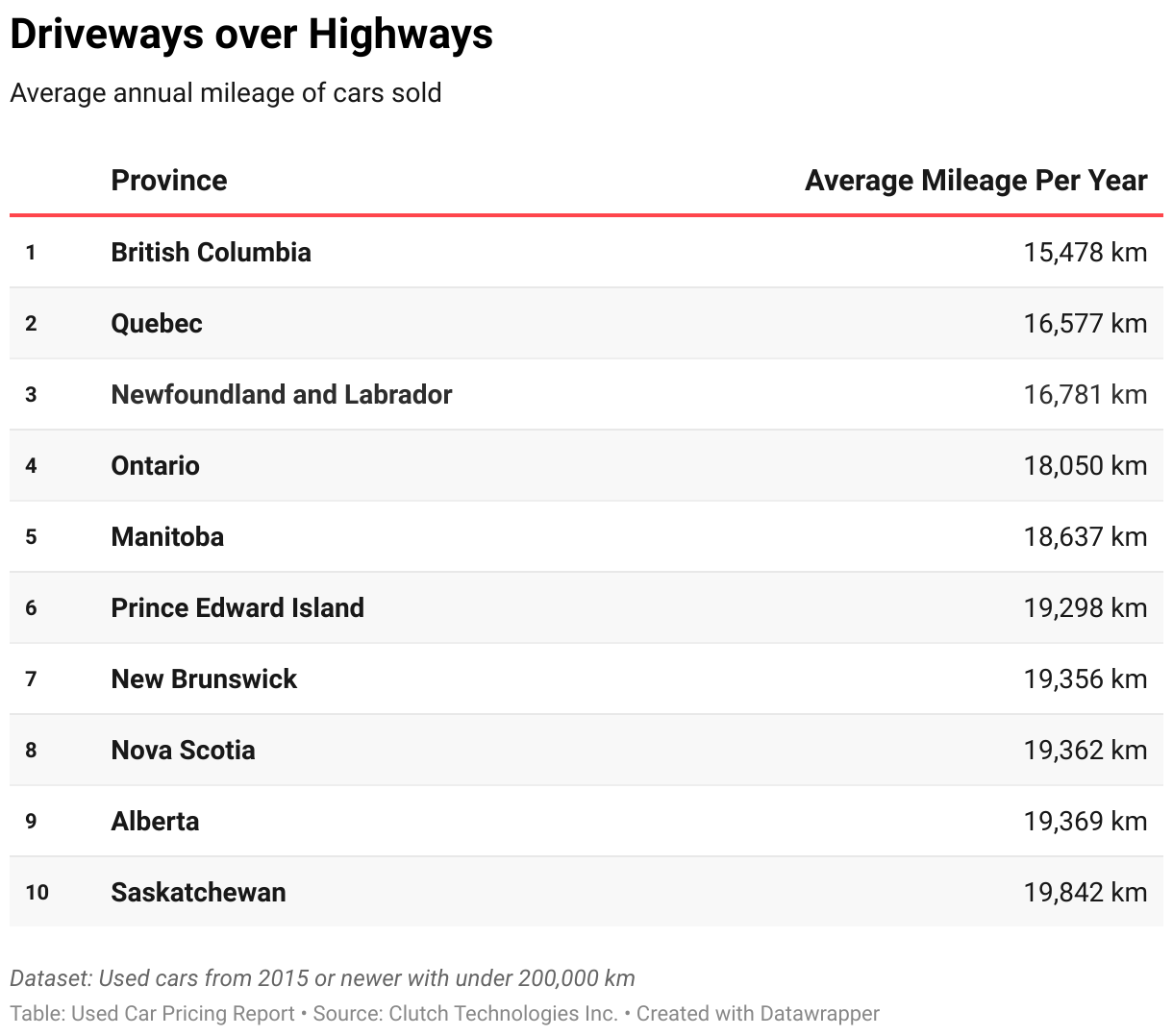
British Columbia — 15,478 km per year (lowest annual mileage)
BC drivers put fewer kilometres on their vehicles than anyone else in Canada. Dense cities, shorter commutes, and a high concentration of EV owners help keep yearly mileage low, which often leads to better-condition vehicles staying in the market.
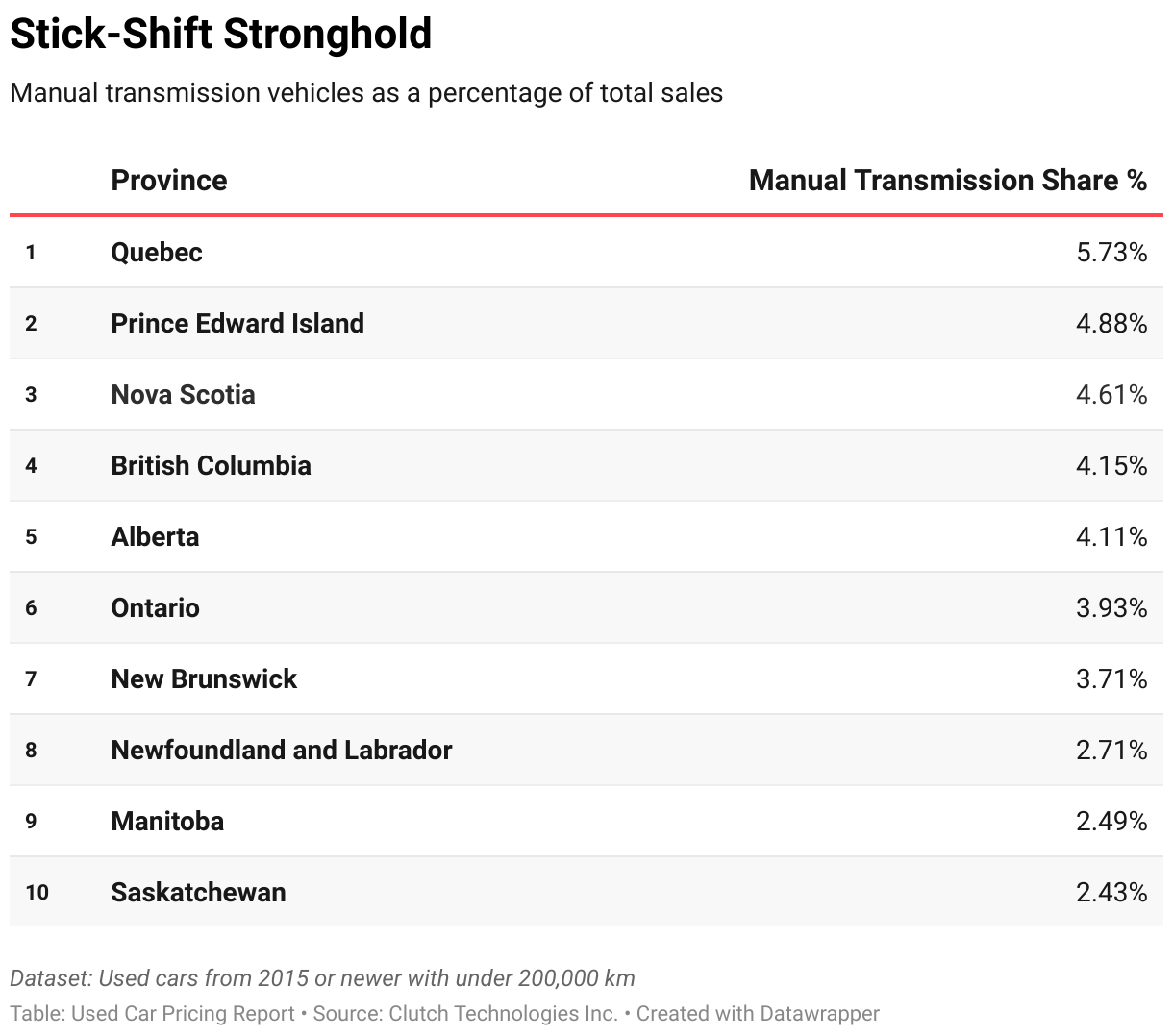
Quebec — 5.7% manual transmission share
Quebec remains Canada’s last bastion of manual transmissions. Many of the province’s older, budget-friendly vehicles still offer a clutch pedal, and buyers continue choosing them at the highest rate in the country.
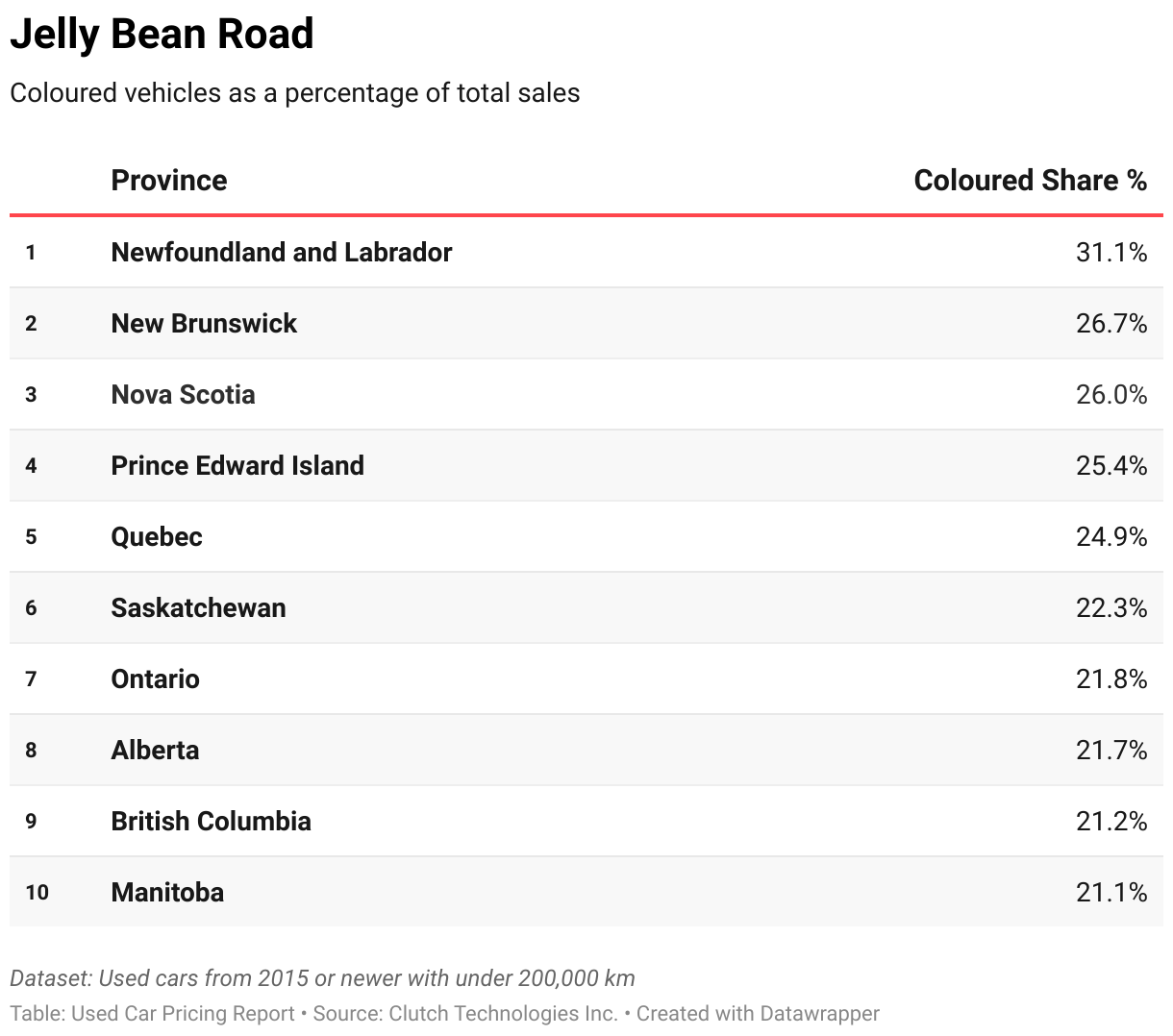
Newfoundland & Labrador — 31% chromatic colours
Newfoundland & Labrador embraces colour on the road much like it does on its famous row houses. Thirty-one percent of used vehicles sold wear bright, chromatic paint rather than black, white, grey, or silver. The result is a used-car landscape that feels as lively as the province’s coastal neighbourhoods.
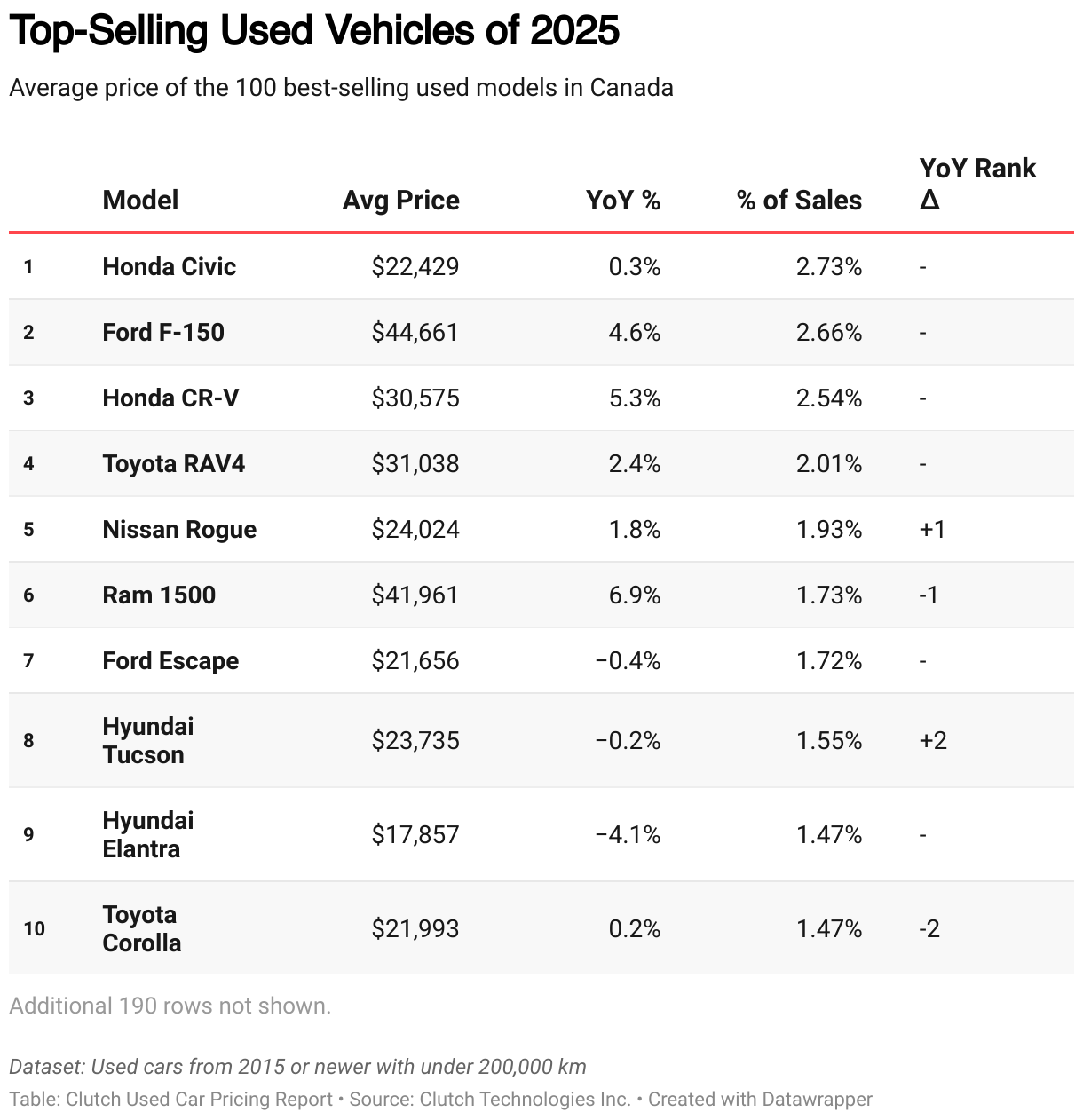
Now that we’ve had some fun, we’ll transition into the real rankings. What cars are Canadians buying the most.
The Honda Civic finished the year as Canada’s best-selling used vehicle once again. Its average price landed at $22,429, which is up 0.25% year over year, reflecting steady demand across the country. The top four overall nameplates were unchanged from last year, underscoring how stable the core of the used-car market remains.
Top-Selling Cars
- Honda Civic
- Toyota Corolla
- Hyundai Elantra
Top-Selling SUVs
- Honda CR-V
- Toyota RAV4
- Hyundai Tucson
Top-Selling Trucks
- Ford F-150
- Ram 1500
- GMC Sierra 1500
Top-Selling EVs
- Tesla Model 3
- Tesla Model Y
- Ford Mustang Mach-E
Top-Selling Hybrids
- Toyota RAV4 Hybrid
- Honda CR-V Hybrid
- Ford Escape Hybrid
Top-Selling Cars Under $15,000
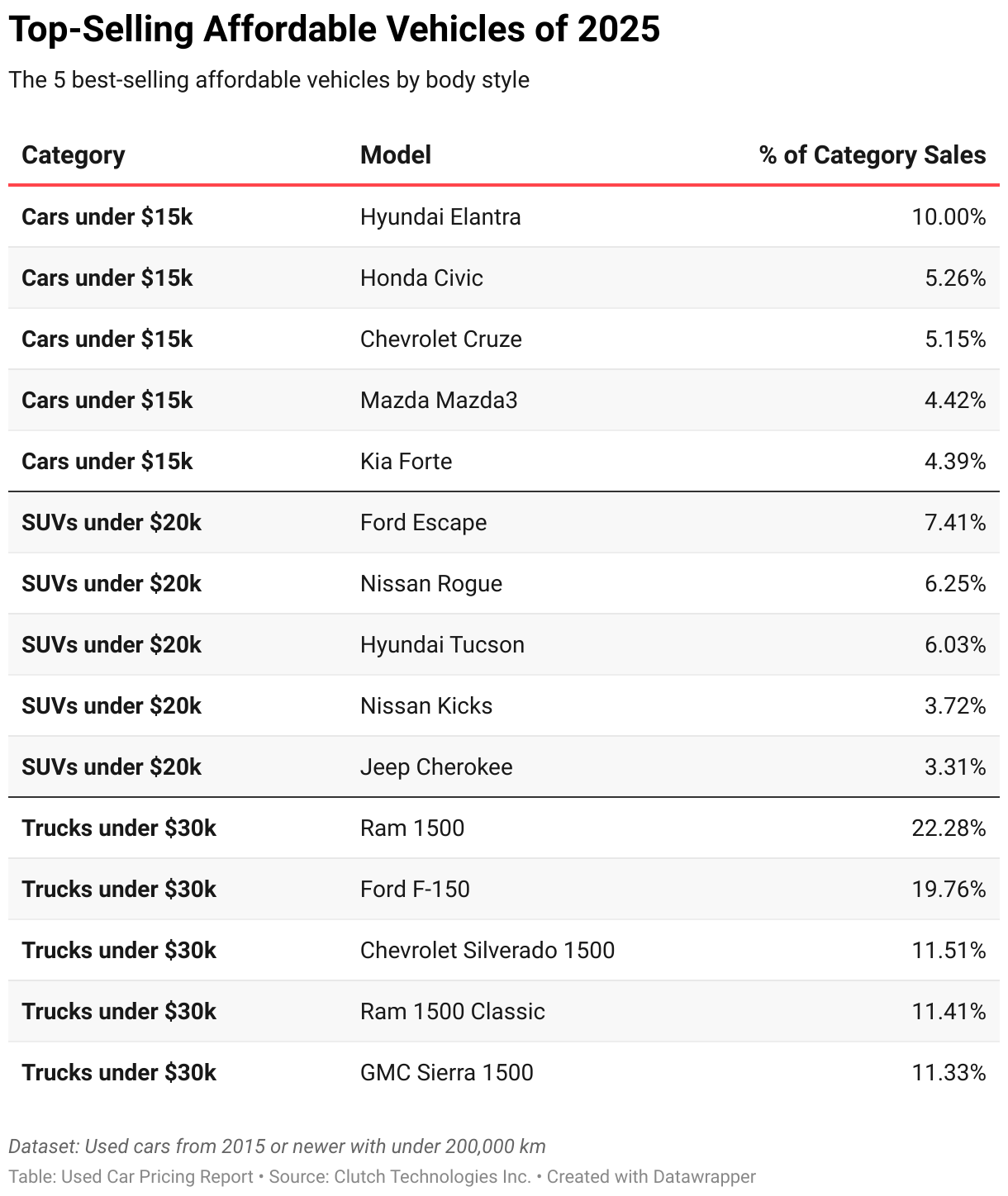
The affordable-car market had a clear standout: the Hyundai Elantra finished the year as the undisputed volume leader. It sold nearly double the units of the next two contenders combined and remained the most dependable gateway into the sub-$15k market.
- Hyundai Elantra
- Honda Civic
- Chevrolet Cruze
Top-Selling SUVs Under $20,000
Shoppers gravitated toward familiar value crossovers. The Ford Escape held onto its top spot thanks to plentiful supply and low ownership costs, while the Nissan Rogue and Hyundai Tucson remained strong alternatives for buyers chasing practicality at a lower price point.
- Ford Escape
- Nissan Rogue
- Hyundai Tucson
Top-Selling Trucks Under $30,000
The affordable truck market was led by a familiar face. The Ram 1500 finished first, offering buyers a lower entry point than other half-ton options. The Ford F-150 followed closely while the Chevrolet Silverado 1500 barely inched out the Ram 1500 Classic and GMC Sierra 1500 for third.
- Ram 1500
- Ford F-150
- Chevrolet Silverado 1500
No Toyotas on these affordability lists. The kings of reliability command higher prices, resulting in fewer sales in the affordability brackets.
Fuel Type Hype
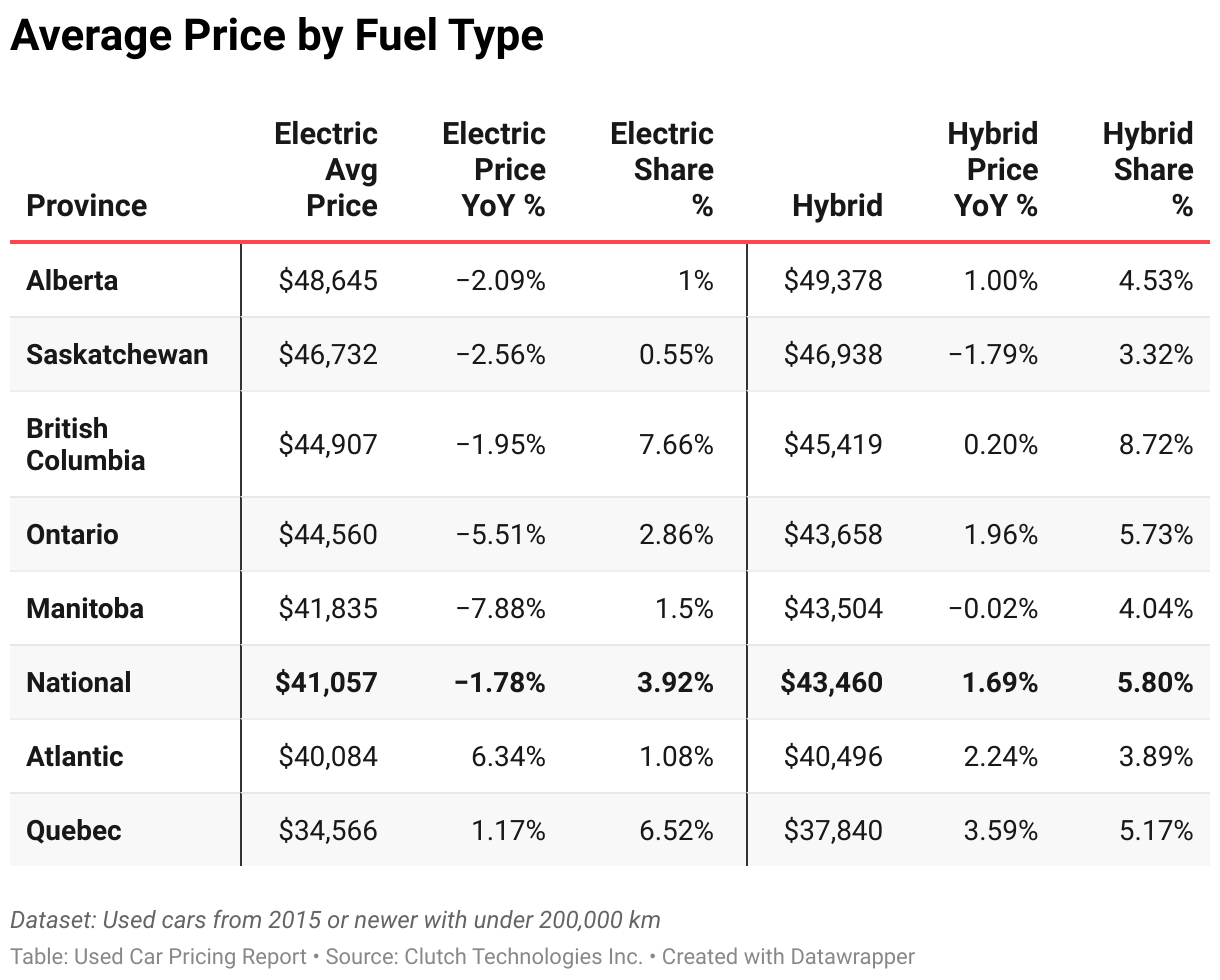
The fuel-type split shows a market gradually shifting toward electrification. EV and hybrid shares both increased meaningfully compared with 2024, while gasoline slipped below 91% of sales for the first time.
Electric (EV)
EV prices averaged $41,057, down slightly year over year. Even with softer pricing, EVs expanded from 3.06% to 3.92% of national used-vehicle sales. The increase reflects greater availability of late-model Teslas, Bolts, and other mainstream EVs cycling into the used market.
Hybrid
Hybrids averaged $43,620, increasing 1.7% YoY. Adoption continued climbing, with share rising from 4.68% to 5.8%. Toyota and Honda hybrid SUVs accounted for much of the growth, reinforcing hybrids as a stable middle ground between gasoline and full EVs.
Gasoline
Gasoline vehicles still account for the vast majority of used-vehicle sales, although share declined from 92.27% to 90.28%. Prices rose to $31,701, up 2.55% YoY, driven mostly by trucks and larger SUVs, which continue to dominate the gasoline segment.
Electrified Market Breakout
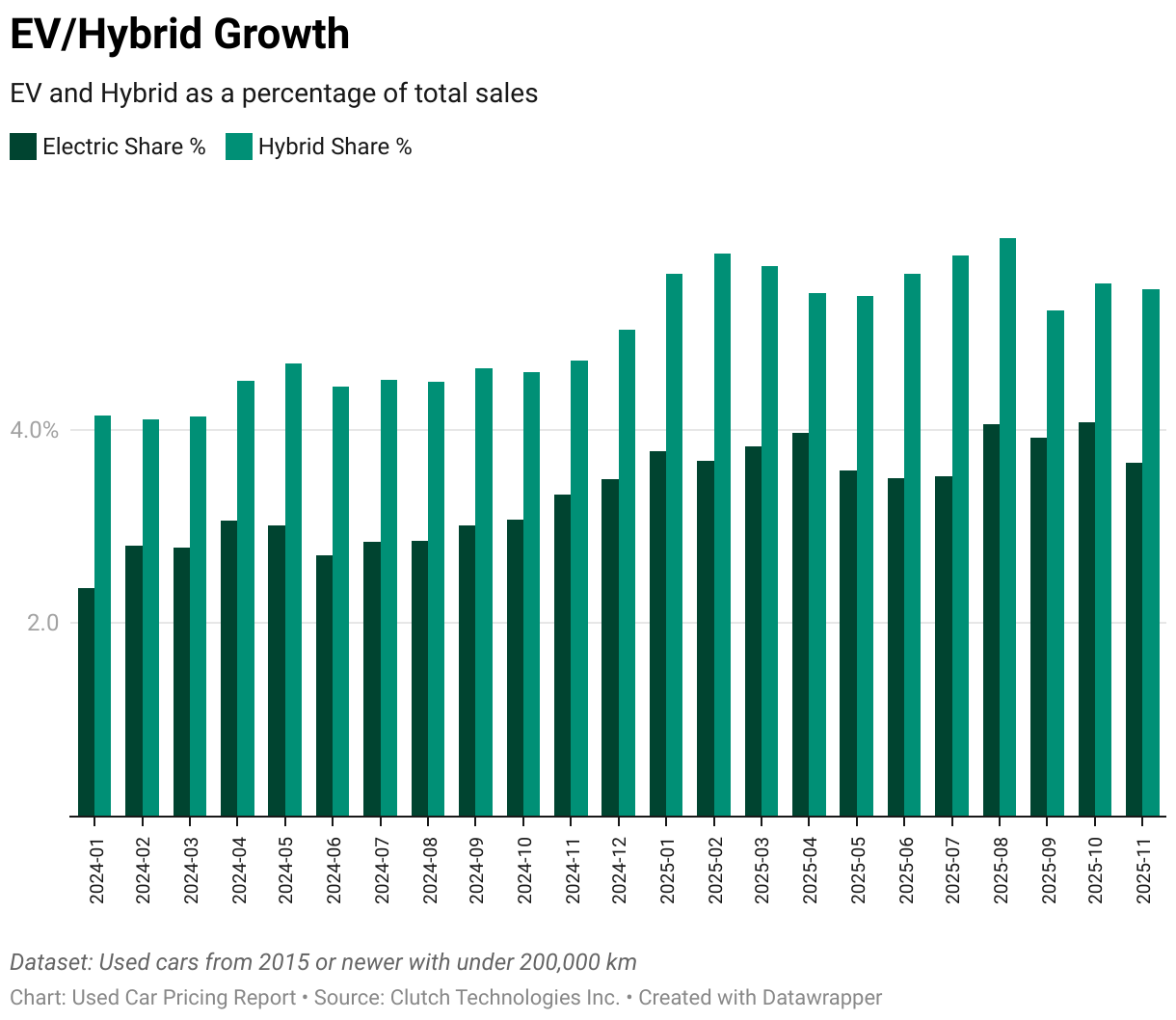
Combined EV and hybrid share increased from 7.74% in 2024 to 9.72% in 2025.
That shift is the clearest indication yet that electrification is becoming a mainstream part of the used-vehicle market. Every province posted gains, led by BC, Quebec, and Ontario, where infrastructure maturity and stronger used-EV supply made electrified vehicles more accessible.
The broad pattern is straightforward:
- EV share climbed as more late-model supply arrived and prices fell.
- Hybrid share rose thanks to persistent demand and new models entering the market.
- Gasoline share edged down as electrified alternatives attracted more shoppers.
Electrified vehicles are no longer a niche segment in the used market; they now represent a meaningful share of national sales at accessible prices.
What Drove EV Prices Year Over Year
EV prices in 2025 ended slightly lower than in 2024, but the forces behind that change pulled in very different directions. Three things mattered most: the type of EVs entering the used market, how much each model depreciated, and which new models appeared for the first time.
1. The mix of EVs got more expensive
+ $3,992.21
More of the EVs entering the used market in 2025 were newer and higher-priced to begin with. Electric crossovers and trucks made up a larger share of sales than in 2024, which naturally pushed the average price upward.
2. Individual EV models lost value
– $4,909.53
Most EVs simply got cheaper. Models like the Tesla Model 3, Model Y, Chevrolet Bolt, Hyundai Ioniq 5, and Ford Mustang Mach-E all saw meaningful year-over-year depreciation. This drop in like-for-like pricing outweighed the upward pull of the richer mix.
3. New 2025 EV models nudged the average up
+ $694
Several EVs that were not available in the used market last year entered the data for the first time — and they tended to be expensive. These new arrivals added a smaller but still noticeable lift to the overall average.
Major 2025 entrants included:
- Porsche Macan Electric
- Cadillac Optiq
- GMC Sierra EV
- Volkswagen ID. Buzz
- Dodge Charger Daytona (electric)
Putting it all together:
The richer mix and new premium models pushed prices up, while heavier depreciation across the most common EVs pushed prices down even further. The net result was a small decline in the average used-EV price despite more expensive vehicles flowing into the market.
Electrified Outlook
Automakers continued adjusting their electrified strategies throughout 2025, and those decisions directly shaped what flowed into the used market.
Expansion of Electrified Lineups
Nearly every major OEM broadened its EV and hybrid offerings. Toyota and Honda leaned more heavily into hybrid SUVs, while Ford, GM, and Stellantis accelerated the rollout of electric trucks and crossovers. These newly launched models now form the earliest wave of 2025 used EV inventory.
Shifts in Pricing Strategy
Manufacturers continued aggressive EV price reductions on the new-car side, which pushed faster depreciation into the used market. Hybrids largely avoided these cuts and maintained stronger residual values, reflecting consistent demand and lower supply volatility.
Provincial Adoption Patterns
BC and Quebec stayed well ahead of the national average, helped by stronger infrastructure and established incentive ecosystems. Ontario gained momentum through 2025 thanks to falling EV transaction prices and improved availability. The Prairies and Atlantic provinces saw slower but steady increases in electrified share.
Overall, 2025 marked a transition year where OEM strategies directly increased EV and hybrid availability in the used market, even as pricing pressure intensified.
Charging Infrastructure & Incentives
Federal EV Mandate Review
The federal review of Canada’s EV sales mandate still casts uncertainty in the new-vehicle market, but used-EV demand continues rising. Many consumers shifted interest toward used EVs as new-EV pricing and policy direction remain unclear. The outcome of the review is expected to influence used-EV availability over the next 2–4 years.
Provincial Incentive Landscape
Provincial programs continued to diverge.
- Although their policies softened in 2025, BC and Quebec maintained the strongest support, reinforcing their position as the leading markets for electrified vehicles.
- Other provinces operated with reduced or no direct consumer incentives, which slowed adoption but did not reverse the upward trend.
Infrastructure Growth and Gaps
Charging infrastructure expanded nationwide, with the largest gains in urban centres. Rural coverage continued to lag, creating regional divides in EV practicality. The growth of workplace charging and multi-unit residential retrofits helped broaden accessibility, although infrastructure remains uneven across the country.
Together, incentives, provincial differences, and infrastructure developments shaped the pace of electrified adoption throughout 2025, with a clear indication that demand will continue rising as charging access improves and used-EV prices become more approachable.
Body Style Deep Dive
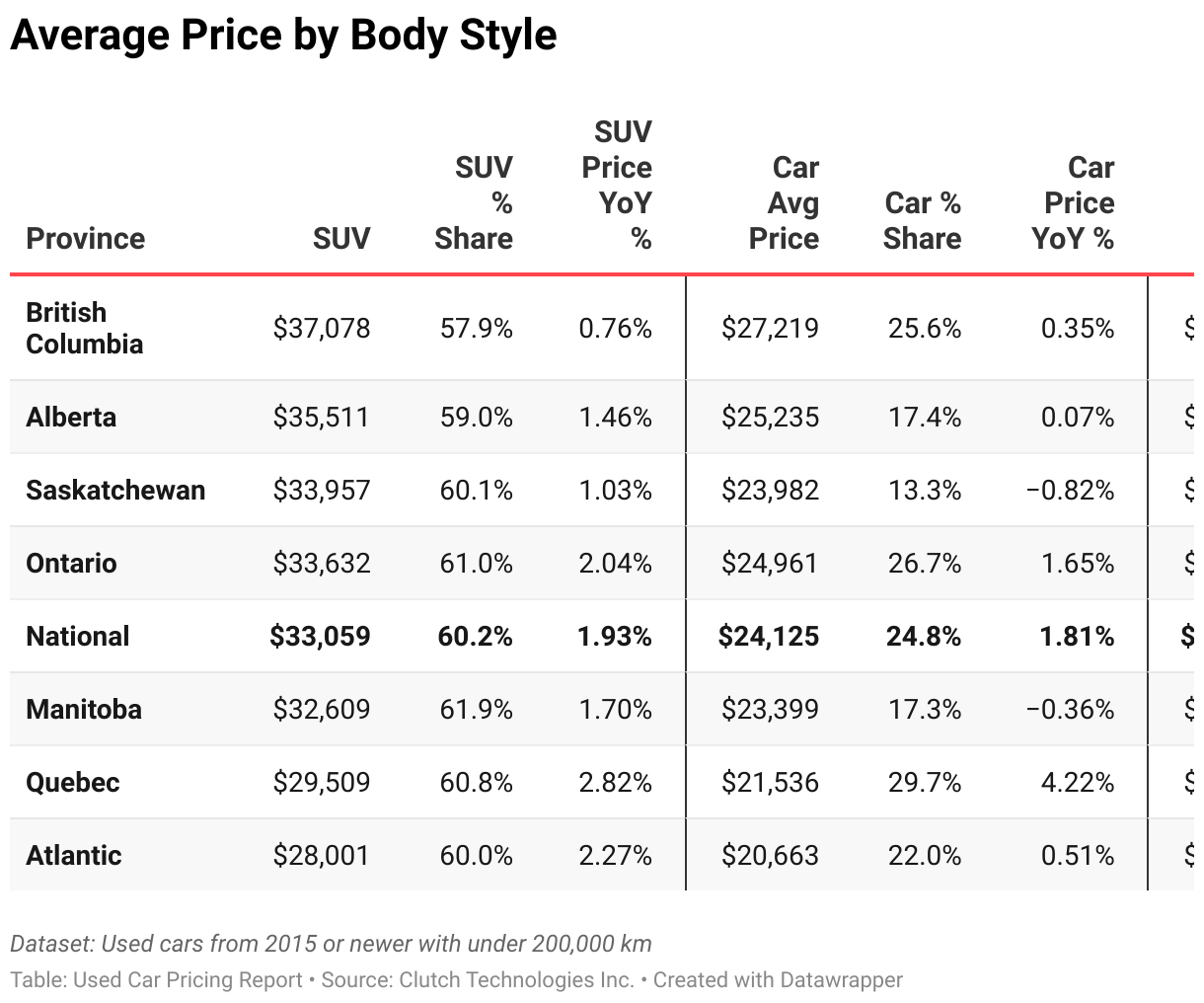
Body style preferences continued to shift in 2025, and the pattern was consistent across most provinces: SUVs gained influence, cars lost ground, and trucks remained steady but powerful in their impact on average price. The transition toward subcompact SUVs is now one of the clearest structural changes in the used-vehicle market.
SUVs
Average Price: $33,059 (+1.93% YoY)
Market Share: 60.2% (up from 57.3% in 2024)
SUVs strengthened their position as the country’s dominant body style. Gains were driven by both mainstream crossovers and a rising mix of electrified SUVs, which elevated prices even as individual models continued to depreciate.
Provincial differences were significant: BC had the most expensive SUVs in the country but also the lowest SUV share, reflecting a tilt toward premium crossovers and EVs over conventional utility vehicles. Manitoba stood at the other end with the highest SUV share.
Cars
Average Price: $24,125 (+1.81% YoY)
Market Share: 24.8% (down from 27.5% in 2024)
Car share continued to shrink as buyers shifted toward small SUVs. Demand was strongest in Quebec, which remained the most car-heavy province in the country. At the opposite end, BC had the most expensive used cars, driven by higher adoption of premium sedans and EVs.
This steady decline in car share is closely tied to limited new-car affordability: fewer low-priced sedans are entering the used market, and many shoppers now treat subcompact SUVs as the practical successor to the compact sedan segment.
Trucks
Average Price: $47,286 (+4.61% YoY)
Market Share: 15.0% (slightly down from 15.2% in 2024)
Truck pricing rose more than any other body style, lifted by both strong demand for full-size pickups and a growing share of late-model inventory with higher MSRP origins. National truck share held almost steady, but the regional story was more dynamic: Quebec and the Atlantic provinces both saw truck share rise, marking a notable shift given these regions have historically leaned more toward compact cars and SUVs.
The biggest shift in 2025 was the rise of subcompact SUVs as the new entry-level vehicle. Models like the HR-V, Trax, Venue, Kicks, and Crosstrek increasingly filled the same role that compact sedans and hatchbacks once dominated. These smaller SUVs brought better ground clearance, more cargo flexibility, and price points still accessible to first-time buyers.
As affordable cars became scarcer and more expensive to source, subcompact SUVs moved in to take their place, reshaping the lower end of the market and reinforcing SUVs’ dominant national share.
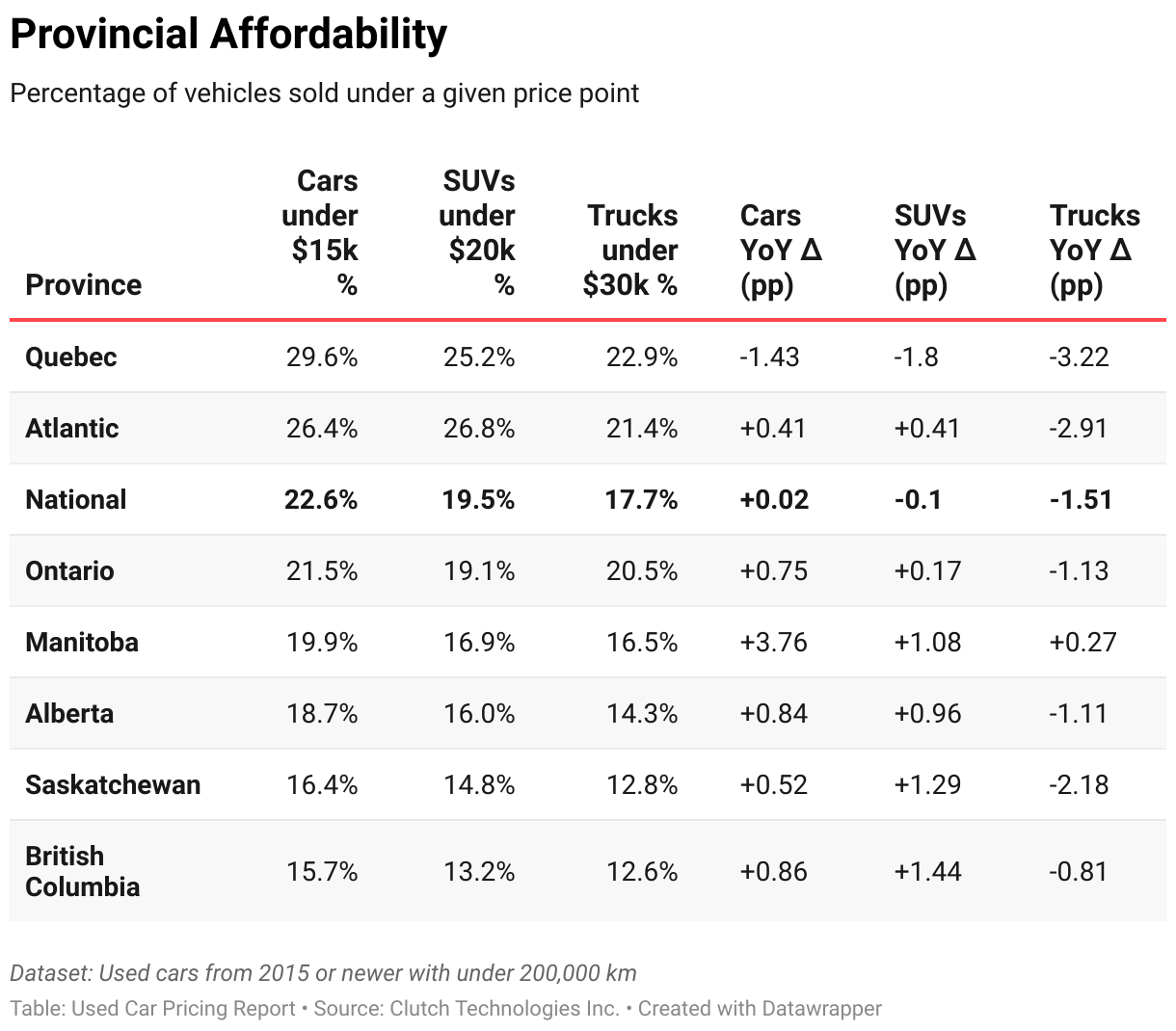
Affordability held up surprisingly well in 2025, but the picture varies dramatically depending on where you shop. Quebec and Atlantic Canada remain the easiest places in the country to find lower-priced used vehicles, thanks to older inventory and a stronger supply of compact cars and value-oriented SUVs. Quebec leads the nation in affordable cars (29.6% under $15k), while Atlantic tops the list for affordable SUVs (26.8% under $20k). Both regions also maintain some of the highest shares of sub-$30k trucks.
At the other end, British Columbia remains the country’s least affordable market, with the smallest share of vehicles under affordability thresholds (e.g., just 15.7% of cars under $15k). This is driven by a newer vehicle mix and stronger adoption of premium SUVs and electrified models.
Compared with 2024, most provinces saw small improvements in car and SUV affordability, especially in Manitoba, BC, and Saskatchewan. The pressure point is trucks: affordable trucks declined almost everywhere, reflecting higher used-truck pricing and fewer late-model pickups available below $30k.
In short, Canada’s affordability landscape is splitting in two: regions with older, value-heavy inventory are holding affordability steady, while provinces with newer or more electrified fleets are seeing the low-price end thin out.
Looking Forward: What to Expect in 2026
The used-car market enters 2026 with clear momentum and a few unresolved questions. Average selling prices are likely to drift upward, not because individual vehicles are becoming more expensive, but because the mix keeps tilting toward larger, newer, and more premium models. That shift should continue even as like-for-like depreciation remains the dominant force inside most segments.
Electrified vehicles will keep expanding their footprint. Hybrids and EVs are poised for another year of share gains, though the speed of that growth hinges on the federal EV strategy review and how quickly provinces align incentives and infrastructure. Meanwhile, cars are expected to give up more ground to SUVs and crossovers, reinforcing the multi-year reshaping of Canada’s vehicle mix.
Affordability will remain a pressure point. The sub-$20k market will stay supply-constrained, supported mostly by older inventory entering the ecosystem. Anything newer will continue to sit well above those thresholds. The real wild card is sentiment: if consumer confidence softens, depreciation could accelerate; if it stays firm, used prices may hold up more than expected.
2026 won’t bring a sudden break from the trends of 2025, but it will reveal how durable these shifts really are.

.avif)
.avif)


